Europa Ocean Exploration | Earth-to-Europa Missions
joinwithdeals.com >> Space>> Europa Ocean Exploration | Earth-to-Europa Missions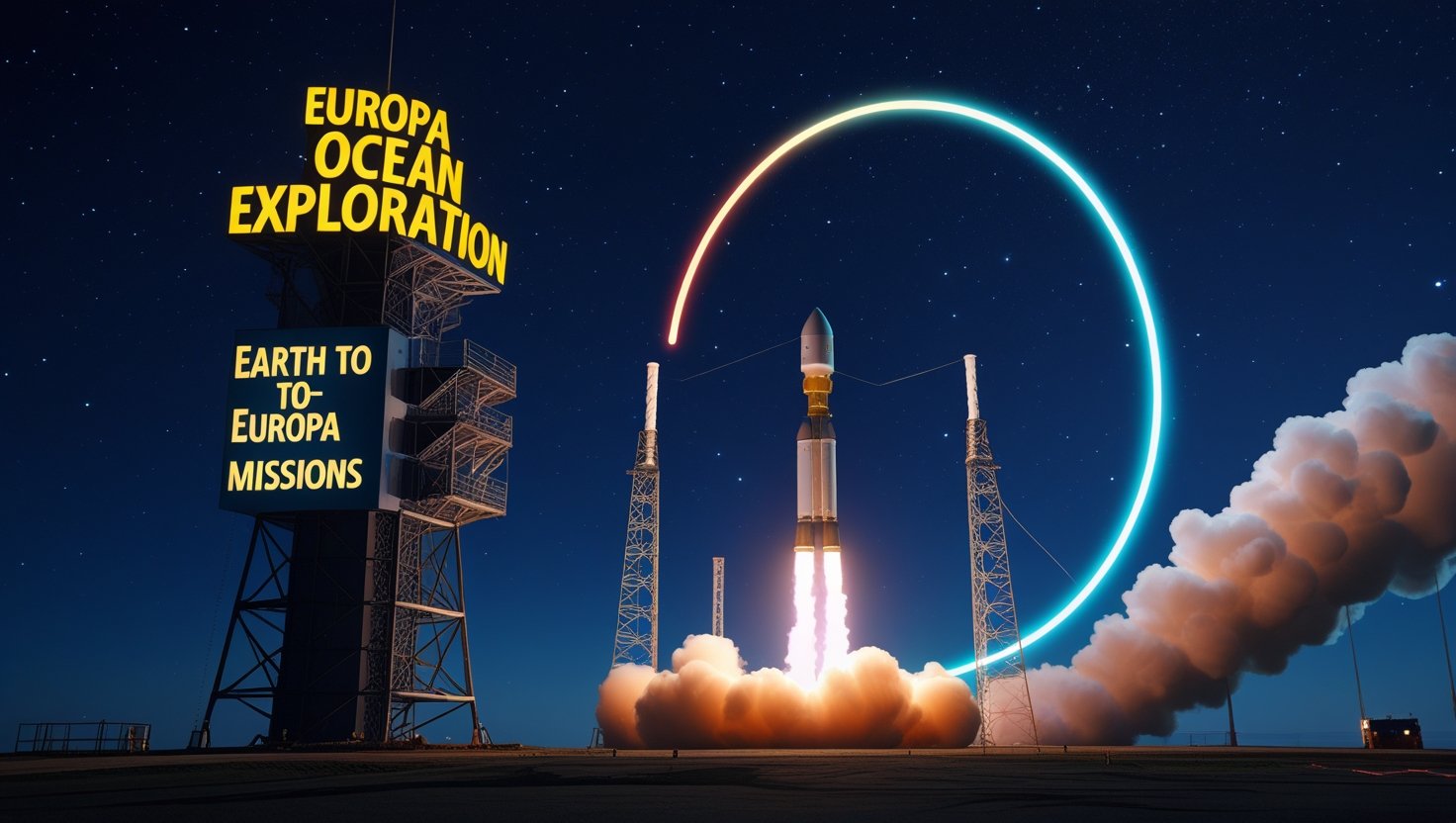
Europa Ocean Exploration | Earth-to-Europa Missions
Step into a journey where silence meets science, Europa Ocean Exploration opens a window into a hidden world beneath icy surfaces. Venture deeper into the unknown as ancient mysteries blend with cutting-edge discovery. This exploration invites you to witness how our quest for knowledge bridges Earth and Europa, revealing secrets beneath a shimmering ice shell that may redefine life beyond our planet.
The Grand Vision:
Humanity’s quest for knowledge has always reached toward the stars. Now, bold new missions are paving the way for travel from Earth to Europa, one of Jupiter’s most enigmatic moons. This grand vision is not only about technological triumph but also about exploring the mysteries of extraterrestrial oceans that could reshape our understanding of life.
Ambitious programs such as NASA’s Europa Clipper are designed to probe beneath the crust of this frozen moon to determine if its hidden seas may harbor the essential ingredients for life. Integrating the expertise of engineers, scientists, and visionaries, these missions represent a risk-tolerant leap into uncharted territory that merges cutting-edge space travel with a timeless human curiosity about the unknown.
Icy Frontiers and Liquid Secrets:
At the heart of the venture lies the allure of an alien ocean beneath a shimmering ice shell. Europa’s subsurface ocean, shielded from cosmic radiation and battered meteorites, is a potential cradle of life. Observations indicate that the moon’s icy crust constantly reshapes itself, hinting at dynamic internal processes. This phenomenon inspires scientists worldwide to consider whether chemical reactions, powered by tidal flexing and radioactive decay, could sustain life in environments that, on the surface, look utterly inhospitable.
Discovering active plumes and chaotic terrains may signal that ocean exploration on Europa can offer key insights into the universal conditions that foster life. The prospects of finding life, even in rudimentary forms, are captivating and are transforming the way we think about habitability across the cosmos.
Engineering Marvels:
Realizing the dream of reaching an alien ocean requires engineering feats of the highest order. Modern spacecraft tasked with Earth-to-Europa Missions are built to withstand extreme conditions. For example, advanced radiation shielding, using materials like titanium and aluminum, protects sensitive electronics from Jupiter’s powerful magnetic field.
Innovations in solar power collection have also been critical since operations at Jupiter’s distance demand efficient energy systems despite the faint sunlight. Every component is engineered to minimize weight while maximizing durability, ensuring that the spacecraft can cope with the long, arduous journey from Earth to Europa. These marvels of modern engineering represent the cutting edge of aerospace technology, merging rigorous design standards with revolutionary approaches that promise to unlock the secrets hidden deep beneath Europa’s icy exterior.
Cosmic Combat:
One of the biggest challenges in interplanetary travel to Europa is dealing with the intense radiation environment of Jupiter’s magnetosphere. Space missions must surmount this challenge through precise planning and fortified design. By incorporating robust shielding and strategic trajectories, mission planners ensure that spacecraft electronics and instruments remain operational despite constant bombardment by high-energy particles.
Technologies that counter radiation effects are not only critical for deep‑space exploration but also drive innovations that benefit other missions facing similar obstacles. As the journey to Europa unfolds, every close flyby and orbital insertion is a calculated move, one that manages risk while pushing technological frontiers. In navigating the cosmic battleground, these pioneering missions demonstrate the resilience of human ingenuity in the face of relentless natural forces.
Pioneering Remote Sensing:
State-of-the-art instruments form the backbone of Europa Ocean Exploration. Robotic systems and sophisticated sensors work in tandem to capture detailed images and measurements of Europa’s surface and subsurface structures. Infrared spectrometers, ice-penetrating radars, and thermal imaging cameras are some of the critical tools that offer scientists glimpses into the moon’s dynamic environment. These instruments help decipher the ice composition, reveal hidden fractures, and analyze potential plumes of water.
Autonomous robotic probes can adapt to rapidly changing conditions, adjusting their data collection to capture every nuance of this extraterrestrial ocean world. With each flyby, the instruments gather invaluable data that could soon answer age-old questions about how life might exist in places once considered barren. In this interplay between technology and nature, the art of remote sensing becomes a bridge connecting Earth-bound laboratories with the farthest reaches of our solar system.
Scientific Breakthroughs:
Beyond the technological and engineering achievements, the true promise of Earth-to-Europa Missions lies in the scientific revelations awaiting discovery. The prospect of an expansive, saltwater ocean under Europa’s ice holds immense implications for astrobiology. Researchers are particularly excited about the possibility of life-supporting environments that might host chemical reactions akin to those at Earth’s hydrothermal vents. By studying surface features and subsurface compositions, scientists hope to unravel the mechanisms that might make Europa habitable.
These breakthroughs not only enhance our knowledge of life in extreme environments but also allow for comparisons with early Earth’s oceans, offering new perspectives on how life might originate and evolve. Every data point collected is a step closer to answering the fundamental question of whether we are alone in the universe, and it fuels the broader dialogue about life, evolution, and cosmic interconnectedness.
Voyage of Discovery:
While current missions like the Europa Clipper set the stage for ocean exploration, the future holds even more ambitious plans. Next‑generation missions might include landers, orbiters with advanced sub-ice radar systems, and even robotic submarines capable of navigating the cold, dark waters beneath Europa’s crust. These future endeavors aim to complement the initial flyby and orbital reconnaissance by getting closer to the ocean itself, perhaps even sampling its chemical composition directly.
The anticipated breakthroughs from these missions are expected to drive a paradigm shift in space exploration, helping scientists refine models of planetary evolution and the potential for life beyond Earth. Each planned mission is not only a technological challenge but also an evolutionary leap that stands to redefine our understanding of an entire world once shrouded in mystery.
Global Collaboration:
The quest to explore Europa’s hidden ocean is not the work of one nation alone; it is a global endeavor. International partnerships merge expertise from leading space agencies, universities, and private entities, pooling resources and intellectual capital to tackle one of science’s most formidable challenges. Collaborative projects foster environments where ideas are exchanged freely, and customized instruments are developed through joint research initiatives.
This cooperation is essential because it leverages diverse perspectives and ideas that drive innovation. By uniting under the shared ambition of deep‑space exploration, the international community underscores a powerful reality: the journey to understand our universe is a collective human pursuit. The collaborative spirit embodied in these missions not only propels technological advancements but also nurtures the hope that our global community, by looking outward, can find common ground and work together toward a brighter future.
Bridging Worlds:
Insights derived from Europa Ocean Exploration extend far beyond the immediate realm of planetary science. The technologies and methodologies perfected during these missions often find applications in other areas, ranging from geological surveys to sophisticated remote sensing techniques used in climate research. The innovations in robotics, materials science, and artificial intelligence stimulate advancements in industries across the globe. Moreover, the dramatic narratives of interplanetary exploration inspire future generations of scientists and engineers who dream of making their mark on the cosmos.
In this way, every discovery on Europa not only broadens our cosmic horizons but also enriches life here on Earth. It is a testament to the power of curiosity and the endless potential that emerges when scientific inquiry meets technical excellence. These breakthroughs forge a meaningful connection between the laboratory and the universe, reminding us that every small step taken on Earth has the potential to echo across the stars.
Expanding Horizons:
Every successful mission to Europa generates ripples that extend into broader scientific, economic, and cultural spheres. The data and innovations gleaned from these missions perpetuate a cycle of discovery that influences new projects, inspires academic research, and even influences policy decisions at national and international levels. As each wave of technological progress is propelled by the challenges of deep‑space exploration, new industries emerge and existing ones evolve, driven by the demands of pushing boundaries.
Likewise, the cultural impact of these missions, sparked by awe-inspiring images and groundbreaking findings, fuels public interest in science and reinforces the importance of supporting exploratory research. The expansive benefits of these missions demonstrate that the journey from Earth to Europa is not merely a scientific adventure but a transformative force that impacts every aspect of society.
The Human Element:
At its core, the pursuit of Europa Ocean Exploration is profoundly human. It is driven by an intrinsic desire to overcome the unknown and a belief that every challenge is an opportunity for growth. The stories of engineers who work tirelessly to perfect spacecraft, scientists who spend countless nights poring over data, and dreamers who imagine a future among the stars resonate with audiences around the globe.
This passion fuels perseverance, a recognition that every setback is just another stepping stone toward uncovering the secrets deep within an alien ocean. Whether viewed through the lens of scientific inquiry or as a testament to human courage and ambition, the journey to Europa embodies the boundless spirit that has defined every great milestone in exploration. It is a journey that continues to unfold, challenging us to rethink what is possible and inviting us to share in the excitement of a universal adventure.
Conclusion:
Europa Ocean Exploration and Earth-to‑Europa Missions remind us that even the most distant horizons are meant to be reached. In quiet determination and groundbreaking collaboration, humanity pushes forward into the cosmic unknown.
FAQs:
1. What is Europa Ocean Exploration?
It is the scientific study of Europa’s hidden ocean beneath its icy surface.
2. What are Earth-to-Europa Missions?
They are space missions designed to travel from Earth to Europa to explore and gather data.
3. Why is Europa’s ocean significant?
Its subsurface ocean may offer clues about extraterrestrial life and planetary evolution.
4. What technologies are used in Europa missions?
Advanced robotics, remote sensing instruments, and robust radiation shielding are key components.
5. Can Europa’s ocean support life?
Evidence suggests it has the necessary ingredients and conditions that could foster life.
6. What future missions are planned for Europa?
Future missions may involve landers, orbiters, and even robotic submarines to explore deeper into the ocean.